
Mostrando entradas con la etiqueta México. Mostrar todas las entradas
Mostrando entradas con la etiqueta México. Mostrar todas las entradas
tacos are everything
My hungarian teacher asked me what we mexican people put on tacos. I think I could talk about this for hours but csak kicsit besélek magyarul: I speak just a little hungarian.
I would like to start by saying that tacos are not what some foreign people think: a curved yellow taco shell with chicken, beans and vegetables. Not Taco Bell either. Having said this, I can move on to the next important thing: tacos are tortillas filled with something (with some restrictions, though, I'll leave that for another time).
There are diferentes kinds of tortillas: hand-made, machine-made and wheat ("de harina", but with those you'd make a burrito, not a taco). There are many varieties of corn so yu can get tortillas that go from white to yellow, even blue or black. There is also a limitless variety of things you can put inside a tortilla so... the count goes astronomic. For me, in the center of Mexico, the prototypical taco would be that filled with bisteck (which I think comes from "beef steak"), chorizo, pastor, costilla.... And this would go on to intestines, brains and whatever you like. Here is a picture of me eating the best tacos sold in León during the morning:

They are marvelous and cost 8 pesos (about .4 dollars) each. Normally this kind of taco has salsa on top, onion, coriander and lime. This place doesn't add coriander and they make a less acid than normal salsa (this one is made with jitomate and not tomate, they're not the same)
This are the best tacos sold in León at night:

In this part of Mexico it's also common to eat tacos dorados (with fried tortillas bent by the half, with salsa on top and even some pork, avocado, tomato, etc). There are tacos sudados (sudor means sweat, those are cooked on steam). For this varieties you explicitly make or go looking for a taco. But we eat tacos almost everyday because during the meals most people have tortillas by their side and put food on them before transporting it to their mouths (therefore tortillas could be considered a kind of cutlery).

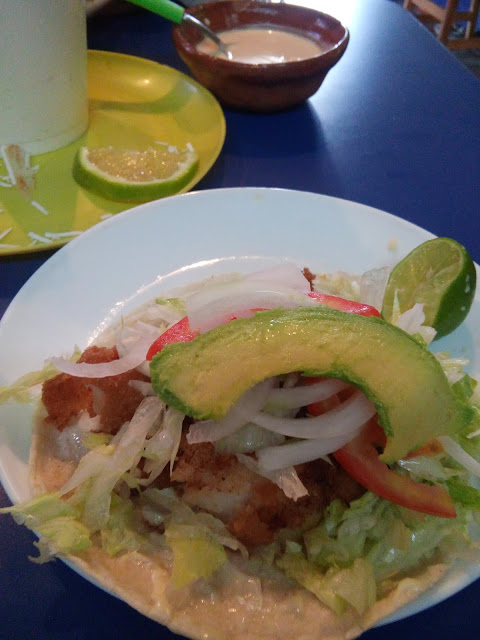
Here in León there are also some very good fish tacos:
And I like some tacos with pork, guacamole and sour cream on top (tacos de carnitas).

In the south of Mexico you'd find different, but equally delicious tacos:


That's it for now. I hope you enyojed this and want to try them all.
Fun fact: I organizado agastronomic tour in my hometown and always try to take my students out to try local places.
sorry'm such a bad photographer.
There are diferentes kinds of tortillas: hand-made, machine-made and wheat ("de harina", but with those you'd make a burrito, not a taco). There are many varieties of corn so yu can get tortillas that go from white to yellow, even blue or black. There is also a limitless variety of things you can put inside a tortilla so... the count goes astronomic. For me, in the center of Mexico, the prototypical taco would be that filled with bisteck (which I think comes from "beef steak"), chorizo, pastor, costilla.... And this would go on to intestines, brains and whatever you like. Here is a picture of me eating the best tacos sold in León during the morning:

 |
| awesome! |

In this part of Mexico it's also common to eat tacos dorados (with fried tortillas bent by the half, with salsa on top and even some pork, avocado, tomato, etc). There are tacos sudados (sudor means sweat, those are cooked on steam). For this varieties you explicitly make or go looking for a taco. But we eat tacos almost everyday because during the meals most people have tortillas by their side and put food on them before transporting it to their mouths (therefore tortillas could be considered a kind of cutlery).

 |
| "normal" meal. you could put on a tortilla with some meat, some rice and some vegetables and make several tacos out of this |
 |
| taco with mole, pork, cheese, rice and salsa |


Fun fact: I organizado agastronomic tour in my hometown and always try to take my students out to try local places.
sorry'm such a bad photographer.
Día de muertos
During today's class, Mr K and I talked about Día de Muertos.
Here I share some of the pictures I showed him and a small explanation of them.
I took this pictures during a trip I made to Pátzcuaro, in the state of Michoacán, in 2012. The 1st of November people in that town spend the night in the cementery, accompanying ther relatives who have passed (I remember being told that they'd do this for 7 years after their deaths). They put ornaments and flowers around their tombs. This is an old, indigenous tradition and I understand that some people in town still speak purépecha.
Pátzcuaro is a town. There's a lake there that is called Pátzcuaro, too. In the lake there's one big island called Janitzio.
There are many tourists for this event. There's always food too.


The cementery.


The following day, I walked around Pátzcuaro and Tzintzuntzan, which is a town 15 kilometers away.


I like Día de muertos because I think that this celebration keeps a lot of symbols from the original cultures. It is good to remember our loved ones. Also, the skeletons remind us in a humorous way that we are not going to live forever.
Here I share some of the pictures I showed him and a small explanation of them.
I took this pictures during a trip I made to Pátzcuaro, in the state of Michoacán, in 2012. The 1st of November people in that town spend the night in the cementery, accompanying ther relatives who have passed (I remember being told that they'd do this for 7 years after their deaths). They put ornaments and flowers around their tombs. This is an old, indigenous tradition and I understand that some people in town still speak purépecha.
Pátzcuaro is a town. There's a lake there that is called Pátzcuaro, too. In the lake there's one big island called Janitzio.
 |
| Janitzio from the boat |
There are many tourists for this event. There's always food too.


The cementery.
 |
| From above |

 |
| The flower petal that looks like a mummy |


The following day, I walked around Pátzcuaro and Tzintzuntzan, which is a town 15 kilometers away.
 |
| Me in "la casa de los once patios", in Pátzcuaro. |
 |
| Pátzcuaro |
 |
| Tzintzuntzan |


I like Día de muertos because I think that this celebration keeps a lot of symbols from the original cultures. It is good to remember our loved ones. Also, the skeletons remind us in a humorous way that we are not going to live forever.
Sobre la folklorización
La
semana pasada leí (las partes que me interesaban de) Resentir lo Queer en América Latina: Diálogos desde/con el sur. Raramente
mi interés por este tipo de teorías críticas y mi formación profesional
intersectan. Sin embargo, mientras leía en el libro un ensayo sobre propuestas
artísticas queer en ecuador me topé
con las siguientes palabras:
"(...)
discursos folklorizados sobre la «ecuatorianidad», cómplices del proyecto
nacional de mestizaje, aparentan valorar la cultura indígena, pero a costa de
folklorización, es decir, de una versión colorida, pintoresca, esterilizada y
—sobre todo— des-sexualizada de lo indígena que desplaza y niega la historia de
marginalización que continúa hasta el presente".
De
alguna forma, encontré una conexión entre esta nueva definición de
folklorización y la práctica de la enseñanza del español para extranjeros en
México. Me parece, de alguna forma, que enseñar español a extranjeros implica
convertir una realidad compleja en un producto de consumo. En nuestras clases
de español hablamos de comida, lugares, música, costumbres mexicanas. Pero
generalmente de una forma acrítica, superficial “una versión colorida,
pintoresca, esterilizada”. Creo que en esto tienen que ver muchas cosas. Por
ejemplo: no conocemos los temas a profundidad, no sabemos manejar los
contenidos con el objetivo de promover un pensamiento crítico, nuestro objetivo
es más usar la cultura para enseñar lengua, queremos mantener las clases
ligeras y divertidas para nuestros estudiantes, no debemos alejarnos de los
contenidos y enfoques de los lugares en los que trabajamos, etc.
En
la escuela donde hago mis prácticas, por ejemplo, hay un montón de actividades semanales a las
que los estudiantes acceden gratuitamente (habiendo pagado unos buenos dólares
por sus cursos semanales, claro está). Hay visitas a museos, tours por la
ciudad, intercambio de idiomas, salidas en grupo a eventos culturales, etc. Ésta
es una forma de mostrar lo bonito de México. Nada de malo en ello. Sin embargo,
una cosa importante en la situación actual de México es la relación entre
empleados y empleadores. Yo, por ejemplo, estoy trabajando allá 4 horas al día.
Soy practicante, y necesito que me firmen horas, pero para mí (y tendría que
investigar si para la ley), la relación con la escuela es una relación laboral,
y nunca me hablaron de ningún tipo de prestaciones fuera del pago de las horas
de clase ($45/h). Los maestros en la escuela, por obligación, participamos
en por lo menos una actividad a la semana. Y en caso de salidas a café para el
intercambio, bebida social, o eventos, nosotros mismos debemos cubrir nuestro
consumo. Cabe mencionar que el tiempo de las actividades extraescolares no nos
lo paga la escuela. Entonces, desde mi punto de vista, la escuela se aprovecha
por un lado de la cultura mexicana para venderse a los extranjeros, y por otro,
de la situación económica del país e informalidad en las relaciones laborales
para maximizar sus utilidades.


De
esta vaga reflexión me quedo con 3 ideas: 1.Tengo que pensar de qué forma
hablar de mi país y mi cultura con los extranjeros sin “exotizarlo”. 2. Quisiera
encontrar la forma de expresar en la escuela que me parece mal que las
actividades extraescolares no se les pague a los maestros. 3. Este tema me
parece explotable para investigarlo formal o informalmente, buscaré a alguien
con quién discutirlo.

Suscribirse a:
Entradas (Atom)